21 Home Office Ideas for Women 2026
You’re working from a kitchen table, a corner of the bedroom, or a “desk” that’s really just a folding table with ambition. It’s not working — and you know it. These 21 home office ideas are built for real spaces, real budgets, and real work lives, whether you’re running a business, clocking in remotely, or just need a spot that doesn’t feel like an afterthought.
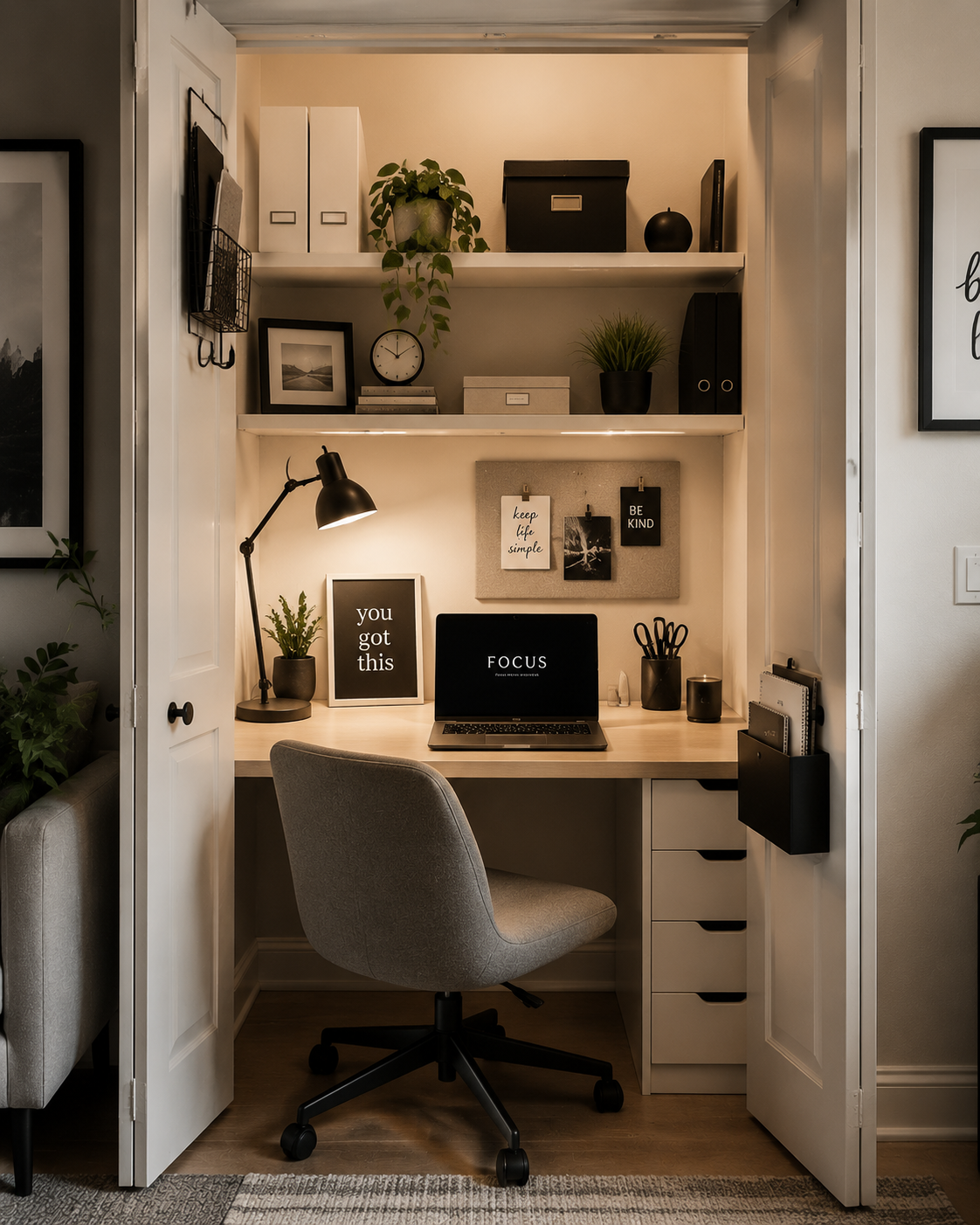
1. Claim a Closet and Turn It Into a Dedicated Cloffice
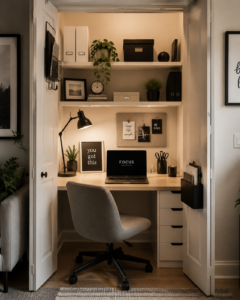
A cloffice — closet office — is the most practical small-space home office move you can make. Remove the hanging rod, add a desktop at desk height (28–30 inches), mount a shelf above for storage, and you’ve got a fully functional workspace you can close the doors on at the end of the day.
This matters: according to a Stanford study, remote workers with a defined workspace report significantly better work-life separation than those without one.
Practical tip: IKEA’s ALEX drawer unit ($139) fits inside most standard closets and gives you filing and supply storage in one piece. Add a $25 LINNMON tabletop across the top for an instant, budget-friendly desktop.
2. Use a Floating Shelf Desk to Save Floor Space in a Tiny Room
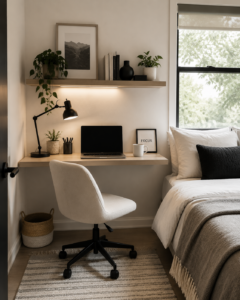
When square footage is the problem, a floating shelf desk is the answer. A single deep shelf (at least 20 inches) mounted at desk height gives you a real work surface without the footprint of a freestanding desk. It’s also renter-friendly if you’re willing to patch two to four holes on the way out.
Practical tip: IKEA’s EKBACKEN countertop ($49–$69) mounted on CAPITA legs ($15) or heavy-duty shelf brackets ($20–$30 at Home Depot) creates a sturdy, surface that holds a monitor without flex. Total cost: under $100.
3. Add a Pegboard Above Your Desk for Renter-Friendly Open Storage
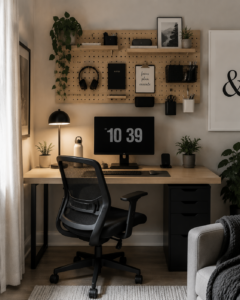
A pegboard turns dead wall space into functional, customizable storage without a single permanent fixture. Hang your scissors, tape, headphones, charger cables, small shelves, and even a small corkboard — all adjustable, all visible, all off your desk surface. IKEA’s SKÅDIS pegboard in white or black runs $14.99–$24.99.
Practical tip: Mount the pegboard with Command Large Strips ($12 at Target) if you’re renting. It holds up to 16 lbs per strip — enough for a fully loaded pegboard setup, as long as you’re not storing books on it.
4. Create a Motivational Gallery Wall That Actually Keeps You Focused
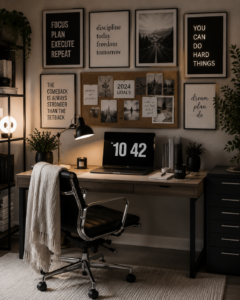
A gallery wall behind your desk isn’t just decoration — it defines your workspace visually and makes the background look intentional on video calls. Stick to a consistent frame color, a mix of text prints and one or two personal photos, and no more than 7–9 pieces. IKEA RIBBA frames ($4–$13) and Etsy digital prints ($3–$8 each, print at home) make this achievable for under $60.
Practical tip: Canva has hundreds of free motivational and aesthetic print templates sized for standard frames. Download, print at your local FedEx ($1–$3 per page), and you have custom wall art for almost nothing.
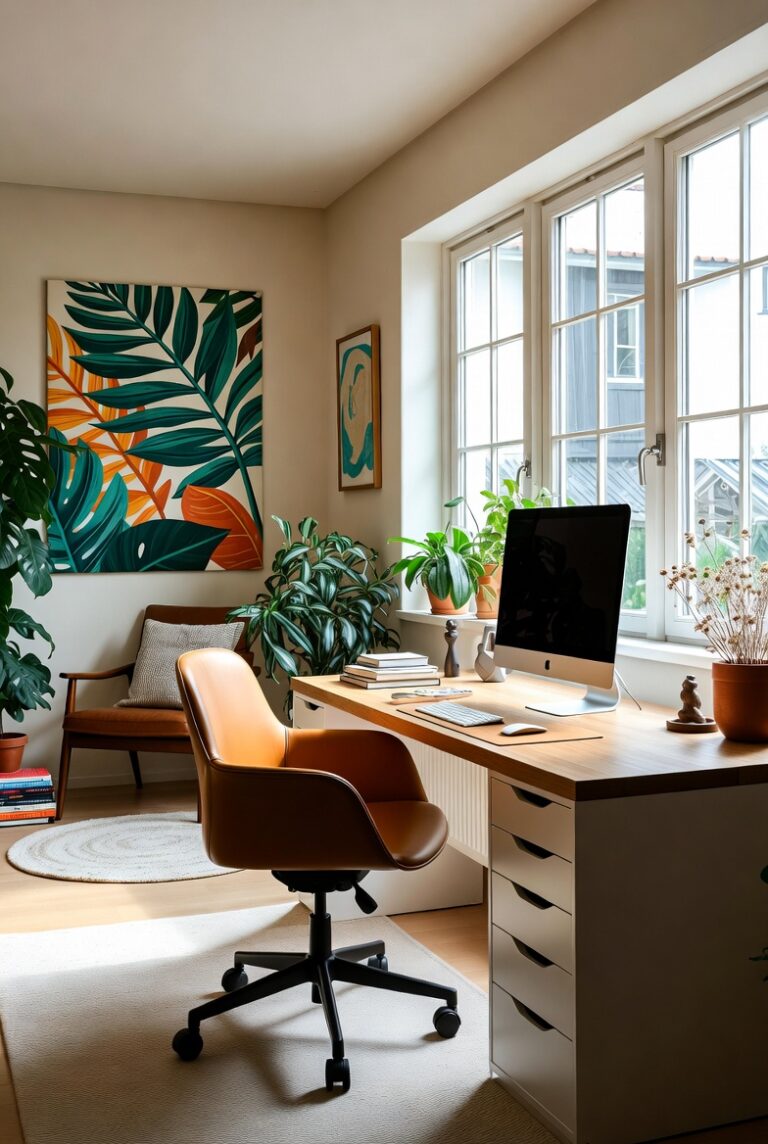
5. Invest in a Proper Ergonomic Chair Before Anything Else
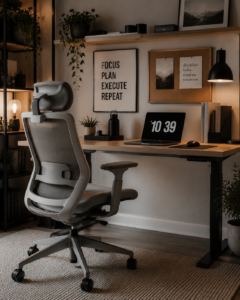
This is the one piece of advice that almost every home office list buries or skips entirely: your chair matters more than your desk, your decor, and your organization system combined. If your back hurts by noon, you can’t work effectively, period. A bad chair is also the #1 reason women abandon their home office setups within six months.
Practical tip: The Branch Ergonomic Chair ($499) and the HON Ignition 2.0 ($300–$400 on Amazon) are the best options under $500 that hold up to daily use. If that’s out of budget right now, the IKEA JÄRVFJÄLLET ($229) is a solid starter ergonomic chair with lumbar support.
6. Use Removable Wallpaper to Create an Accent Wall Behind Your Desk
One wallpapered wall behind your desk does more for the look and feel of your office than almost any other single upgrade. It makes the space feel designed, gives your video call background real personality, and completely transforms a blank rental wall. Chasing Paper, Tempaper, and Spoonflower all make peel-and-stick wallpaper starting at $48–$65 per roll.
Practical tip: A standard 8×10 ft wall needs approximately four rolls. Measure first, order one extra roll for pattern matching, and start hanging from the center of the wall outward — not from a corner.
7. Build a Command Center Wall for Paperwork, Calendars, and To-Do Lists
If your desk is buried in paper, the problem isn’t the paper — it’s the lack of a system to get it off the desk. A command center wall uses a combination of a corkboard, a magnetic whiteboard, a wall calendar, and small bins to move all your active paperwork vertical. Quartet and Umbra both make combination board systems ($30–$60 at Target and Amazon).
Practical tip: Mount everything at eye level when seated, not standing. Most people hang things too high and then never actually look at them. The system only works if you use it.
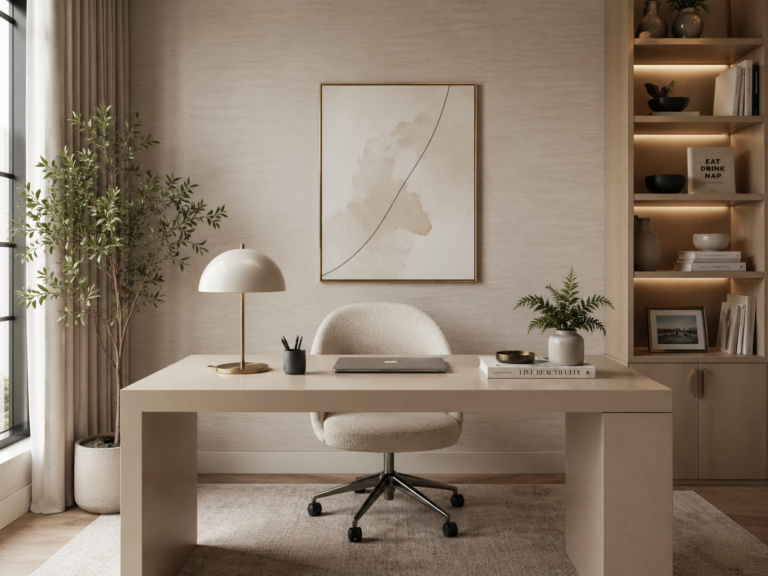
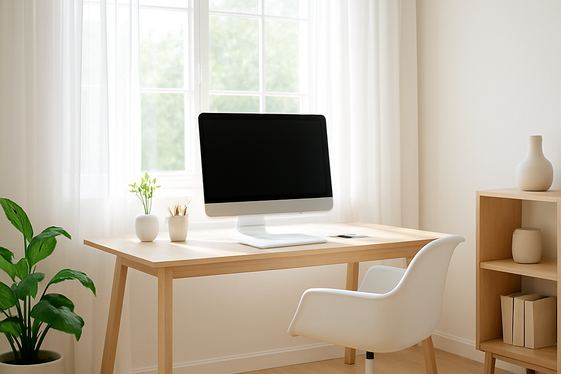
8. Choose a White or Light Wood Desk to Keep a Small Office Feeling Open
Dark desks in small rooms shrink the space visually. A white or light oak desk keeps the room feeling open and airy, which matters a lot when your office is a corner of a bedroom or a narrow nook. The IKEA MICKE desk ($99) in white and the ALEX desk ($249) in white are both solid options for compact spaces.
Practical tip: Avoid glass desks if you actually work at your desk. They show fingerprints and smudges constantly and require daily wiping to look presentable — which gets old fast.
9. Add a Small Bookcase as a Desk Riser and Storage Combo
A low two-shelf bookcase placed beside your desk effectively doubles your storage and adds a surface for your printer, scanner, or reference books at the right height. It costs a fraction of a purpose-built desk organizer system and is far more flexible. IKEA’s KALLAX 1×2 unit runs $34.99 and is exactly the right height to sit next to most standard desks.
Practical tip: Use the KALLAX with fabric insert boxes ($7 each) on the bottom shelf for supplies you want hidden, and the top shelf open for things you need to grab quickly. This keeps the setup looking tidy without requiring you to actually be tidy.
10. Use Cable Management Boxes to Eliminate Cord Chaos for Under $20
Cord clutter is one of the most immediate things that makes a home office look unfinished and chaotic. A cable management box hides your power strip, excess cord length, and adapter bricks in a single contained unit. Bluelounge CableBox and the D-Line versions on Amazon both run $15–$25 and make an immediate visual difference.
Practical tip: Route all cords through a single cable sleeve ($8–$12 on Amazon) from the box up to your desk surface. Velcro zip ties ($7) keep everything bundled. Do this once and you won’t touch it again for years.
11. Mount Your Monitor on an Arm to Free Up Precious Desk Space
If your monitor sits on a stand, you’re losing 6–12 inches of usable desk depth for no good reason. A monitor arm mounts to the desk edge, raises your screen to ergonomic eye level, and clears your entire desk surface below. The Ergotron LX is the most recommended option in productivity circles and runs about $45–$55 on Amazon.
Practical tip: While you’re at it, raise the monitor so the top of the screen is at or slightly below eye level when you’re seated with your shoulders relaxed. Most people run their screens too low, which causes neck strain over long work sessions.
12. Dedicate One Drawer Entirely to Charging and Tech Cables
A “junk drawer” for tech isn’t the problem — an unorganized one is. Dedicate one drawer specifically to charging cables, batteries, adapters, and small tech accessories, and use a bamboo drawer organizer insert to keep it sectioned. Amazon Basics bamboo drawer organizers run $12–$18 and fit most standard desk drawers.
Practical tip: Label each cable section with a small label maker ($20 for a Brother P-Touch on Amazon) or masking tape and a marker. When you need the right cable in a hurry, you’ll actually be able to find it.
13. Hang a Large Mirror Near Your Desk to Make a Small Office Feel Bigger
A mirror in a home office isn’t vanity — it’s a space hack. A large mirror positioned to reflect natural light doubles the sense of space in a small room and bounces light into corners that would otherwise stay dark. Target’s Threshold Arch mirror ($79–$129) and Amazon’s Christopher Knight arch mirrors ($45–$75) both work well in compact office setups.
Practical tip: Position it to reflect a window, not your face. You want the light to bounce through the room, not a direct reflection of yourself while you’re trying to work.
14. Use a Rolling Cart as a Portable Supply Station
A rolling cart means your supplies go where you go — from desk to craft table to living room — without you having to carry anything. The IKEA RÅSKOG cart ($39.99) has become a home office staple for good reason: three tiers, sturdy metal construction, and a size that fits into tight spaces without issue.
Practical tip: Assign a specific function to each tier: top for daily-use supplies (pens, sticky notes, scissors), middle for in-progress projects, bottom for rarely-used items. Keeping the categories fixed means you stop rummaging.
15. Bring in One Quality Desk Lamp That Actually Lights Your Work Surface
Most people work under ambient overhead lighting that casts shadows directly onto their desk. A task lamp positioned to light your work surface from the side (not above) reduces eye strain significantly. The BenQ e-Reading LED Desk Lamp ($79–$99) is a cult favorite among remote workers — it auto-adjusts brightness based on room lighting and doesn’t create screen glare.
Practical tip: Position your desk lamp to the left if you’re right-handed, to the right if you’re left-handed. This keeps the light source opposite your writing hand and prevents your hand from casting a shadow on your work.
16. Create a Budget Home Office With Just a Door and Two Sawhorses
The cheapest functional desk setup that actually works: two sawhorses ($15–$20 each at Home Depot) plus a hollow-core interior door ($40–$60 at Home Depot). Sand lightly, paint or leave natural, and you have a 6-foot wide workspace for under $100. It’s spacious, stable, and can be fully disassembled when you move.
Practical tip: Add felt pads to the sawhorse tops before placing the door. It prevents the door from sliding and protects the surface from scratches. This setup handles two monitors, a laptop, and all your daily accessories without flex.
17. Use Open Shelving Above the Desk to Keep Reference Materials Visible
Floating shelves above your desk give you the equivalent of a built-in bookcase without the cost or commitment. Style them with a mix of books, labeled storage boxes, and one or two small plants to keep the display functional and not purely decorative. IKEA’s BERGSHULT shelf in white ($29–$45) is deep enough for standard binders and books.
Practical tip: Keep the bottom shelf at least 12–14 inches above your head when seated. Lower than that and you’ll hit it constantly — a frustrating and avoidable problem.
18. Add Soundproofing Panels to a Noisy Home Office Without Renting Damage
If your home office is in a loud space — near a street, next to a kitchen, or in an open-plan apartment — acoustic foam panels make a real difference in call quality and focus. Acoustic foam tiles on Amazon start at $25 for a 12-pack. For a renter-friendly install, mount them with Command Strips on the wall behind your monitor.
Practical tip: You don’t need to cover the entire room. Treating the wall directly behind you absorbs echo on video calls — which is usually the main issue. Six to eight panels strategically placed beats a full room treatment you can’t afford.
19. Get a Standing Desk Converter Instead of Replacing Your Whole Desk
A full standing desk is a big commitment — financially and spatially. A standing desk converter sits on top of your existing desk and raises your monitor and keyboard to standing height when you want it, then folds flat when you don’t. The FlexiSpot M2B converter runs $119–$139 on Amazon and fits most desk surfaces.
Practical tip: Don’t start by standing all day. Build up to 30-minute standing sessions gradually. Most people who buy standing setups and try to use them for hours immediately give up within a week because their feet hurt.
20. Use Matching Storage Boxes to Make Open Shelving Look Intentional
If you have open shelving in your home office, mismatched boxes and random stacks of stuff undo all the visual work of the shelves themselves. Matching storage boxes — same color, same size — make open storage look curated instead of chaotic. IKEA’s TJENA box with lid comes in several colors and runs $4.99–$7.99 each.
Practical tip: Label the front of every box, even if you think you’ll remember what’s inside. You won’t. A label maker or even simple handwritten kraft paper tags ($8 for 100 on Amazon) keeps the system working without guesswork.
21. Set Up a Dedicated Zoom Corner With Lighting, Background, and a Ring Light
How you look on video calls affects how you’re perceived professionally — and most home offices have terrible call setups: backlit windows, cluttered backgrounds, unflattering overhead lighting. A ring light ($25–$40 on Amazon), a clean or styled background wall, and a camera at eye level solves this in one afternoon.
Practical tip: Position the ring light directly in front of you, slightly above eye level. Side lighting creates shadows; front lighting creates the even, flattering look you see in professional video setups. The Neewer 10-inch ring light kit with stand runs $35 on Amazon and includes everything you need.
Final Thoughts
A home office that actually works doesn’t require a spare room, a big budget, or a complete renovation. It requires making a few specific decisions and committing to them. Start with the ergonomics — chair, monitor height, lighting — because those affect your health and output every single day.
Then work outward: storage, decor, soundproofing. Pick two or three of these 21 home office ideas that match your actual situation this week and set them up before the weekend. The longer you wait, the longer you’re working on a kitchen table.